
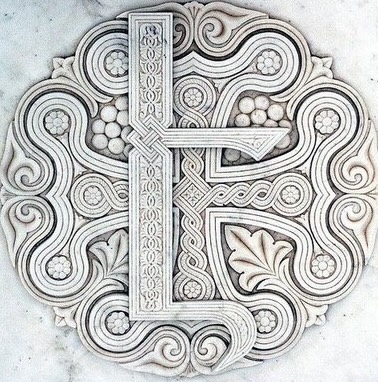
 In the heart of Armenian life, a single letter does more than shape words. It bears a layered symbolism that links language, faith, and identity. The seventh letter of the Armenian alphabet, Է (pronounced “EH”), carries a weight that far surpasses ordinal placement. In Armenian churches and homes, it is a living emblem—one that helps define who we are. It sustains in it our daily practice of language, family rituals, community service, and church attendance. With its numerical value of 7, Է EH is rooted in concepts of completion, wholeness and perfection, as the symbol of God’s presence– a simple affirmation that says “it is.” Է EH functions as the verb to be. It anchors existence reminding us that belonging comes from lived faith and shared traditions, not just a map of where we’re from.
The Armenian Church, in its sacred spaces and liturgical life, is understood as a meeting place between God and humanity. It is where history and eternity intersect—where the prayers of ancestors become the present-tense prayers of the faithful. Է EH as the emblem of God’s breath and existence, sits at the crossroad of temporal and eternal, human memory and divine presence. It marks a continuity of faith: from ancient pre-Christian associations through the transformative Christian proclamation, and into modern Armenian life.
The Armenian heritage—inscribed in history, art, and daily life—invites both pride and humility. Pride in the endurance of faith through times of persecution and upheaval; humility in recognizing that the journey of faith is ongoing, personal, and communal. It is the symbol of God’s presence that challenges each generation to honor ancestors’ sacrifices by cultivating truth, justice, and compassion in the present.
The letter Է EH illustrates how language can sustain national memory and spiritual life in a way that resonates beyond borders. It’s a reminder that culture is lived in everyday practices as much as in history books. Armenia’s history is interwoven with glorious moments, but it is also marked with deep generational wounds that are slow to heal. Historically, Armenian church and state have shared complex entanglements, shaped by empires, wars, and nation-building. These wounds have causes that transcend borders and are intertwined with various social, cultural, and political dynamics. Our wounds often reflect unintentional shortcomings and moments when we fail to live up to our ideals. And sometimes, we intentionally cross boundaries, feel betrayed, lose trust, become vulgar or avenge and attack with total loss of dignity. What we lack today is a healthy balance between church and state—essential for freedom of conscience and religious practice. The ideal stance—one of separation in governance while preserving mutual respect and collaboration in moral and social life—supports the integrity of religious practice and the autonomy of spiritual communities. In modern contexts, this balance helps ensure that sacred spaces remain sanctuaries for devotion, reflection, and communal healing, rather than instruments of political power.
Acknowledging that these times are challenging, and that people are struggling, I stand without taking sides or entering divisive specifics. I belong to the same community and nation and share fundamental human experiences and needs. As an Armenian, I know that our strength lies not in triumph over others but in the dignity we accord to every person—especially in disagreement. A return to a more civil society begins with how we speak, listen, and treat one another. Let us advocate for every individual to be met with dignity and respect, even in disagreement, so that our public life can heal and rise toward what is right, not merely what wins.
If a nation can hold fast to these commitments — practice compassion in every act, support for the vulnerable, just governance, honest conversation, and inclusive community life — it may move toward a more unified and supportive future—one that prioritizes shared humanity and common good over partisan victory.
Է EH invites everyone to consider how faith informs their choices, how they treat others, and how they nurture their communities. At its very core, Christmas and the Epiphany we revere is a celebration of unity and compassion. It beckons us to transcend borders, cultures, and other perceived differences, and to embrace the shared humanity that binds us all. In the midst of global conflicts, the Christmas spirit becomes a universal call for unity, urging us to set aside grievances and focus on the common threads that bind us together. Clearly, we live in a world that is ravaged with conflict. One would be hard-pressed to find a corner of our world that is not currently marked by discord and strife. Nonetheless, this season serves as a poignant reminder of the transformative power of peace, unity, and goodwill. As the festive lights twinkle within our cities and at the Republic Square of the motherland and the sounds of carols fill the air, the Christmas spirit becomes a beacon, encouraging us to pause, reflect, and collectively foster an atmosphere of tranquility during times of heated conflicts around the globe.
May the Է EH inspire us to re-knit the fabric of our community with threads of reverence, service, and empathy. May this season renew our hope that Armenian history, faith, and culture can serve not as a battleground for division but as a wellspring for renewal—bringing us closer to one another and closer to the higher ideals we profess.
In that spirit, let us honor the letter that has long anchored our language and our hearts. Let Է EH guide us to speak with truth, act with mercy, and live with purpose. Let the chorus of our shared humanity outshine disputes; let the Christmas light of the north remind us that unity, courage, and care are within reach when we choose to put people before points, and right before victory.
Happy New Year and a joyful Epiphany!
 thisihumblyspeak
Silva dear, what an appropriate (for our times in despair) and passionately written message. May all your wishes be heard by the deaf ears of everyone around us, and especially by our leaders…
Happy New Year jan!
LikeLike
Beautifully written, Silva! Merry Christmas and Happy New Year
LikeLike
Silva jan
Was, Is and Will Be forever.
So true, so heartfelt, speaking for everyone worried about the situation today, it touched my soul. From your pen to God’s ears.
Snorhavor Nor Daree yev Soorp Dznoont (Happy New Year and Holy Armenian Christmas)
LikeLike